Flatbeds themselves aren’t stacked in use. Cargo on a flatbed can be stacked as long as it’s properly secured and within weight and height limits. Max legal load height for an over-the-road flatbed is typically 13’6″ including the trailer deck.

57+
Years In Business
15+
BRANCH LOCATIONS
4
GENERATIONS OF SERVICE
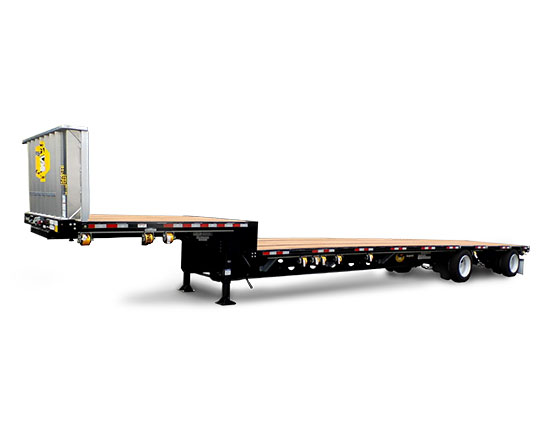
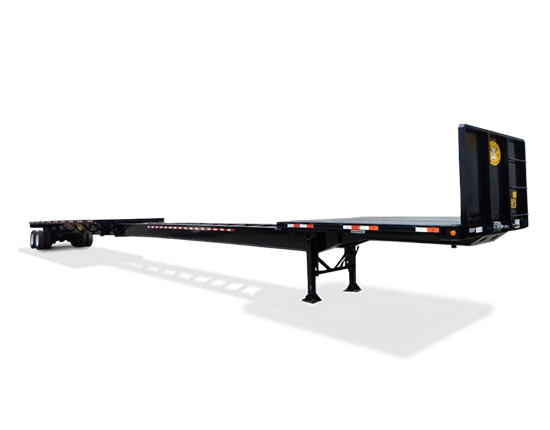
When your load is too tall for a standard flatbed but does not need the lowest deck height of a lowboy, the drop deck is the right call. Also known as a step deck, this trailer has a lowered main deck that gives you extra vertical clearance for taller cargo without requiring a permit for every haul. Perfect for equipment, machinery, and oversized materials that need that extra few inches of headroom. Comes standard with headboards, rub rails, and tandem axles.
Lowered Main Deck for Taller Loads The drop deck design features a lower main deck behind the gooseneck, giving your cargo additional vertical clearance compared to a standard flatbed. This allows taller equipment and materials to be transported legally without requiring an oversized load permit in many cases.
Built-In Standard Equipment Every drop deck comes with headboards, rub rails, and tandem axles as standard. The two-level design also makes it easier to load and secure cargo at a more accessible deck height.
Versatile for a Wide Range of Cargo The step deck handles everything from construction equipment and machinery to oversized industrial materials that fall into that middle ground between a standard flatbed and a lowboy.
DOT-Inspected and Well-Maintained Every unit is processed at one of our state-of-the-art maintenance facilities and is DOT-inspected before delivery.
The Right Tool for Taller Cargo When your load is too tall for a standard flatbed but does not require the full ground clearance of a lowboy, the step deck fills that gap precisely. It gives you the height you need without overcomplicating the haul.
Avoid Oversize Permits When Possible The lowered deck height means many taller loads can be transported without triggering oversize permit requirements that would apply on a standard flatbed. That saves time, paperwork, and cost on loads that fall in that in-between range.
Easier Loading at a Comfortable Height The lower deck makes it more manageable to load and secure cargo compared to a standard flatbed, especially for equipment that is being driven or rolled onto the trailer rather than lifted by crane.
Backed by Eagle Leasing Since 1967 Every trailer in our fleet is maintained at our state-of-the-art facilities and delivered by our professional drivers. Routine maintenance is included free of charge for all rental equipment.

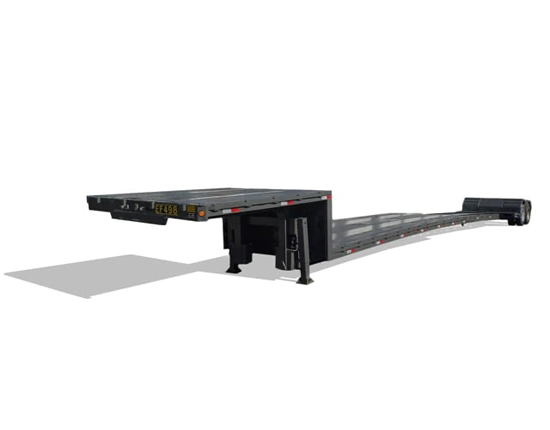
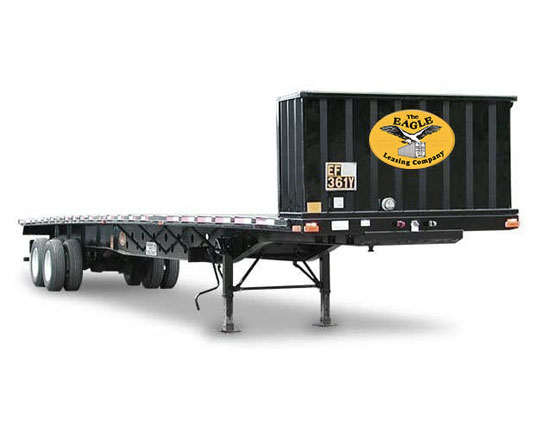
Flatbeds themselves aren’t stacked in use. Cargo on a flatbed can be stacked as long as it’s properly secured and within weight and height limits. Max legal load height for an over-the-road flatbed is typically 13’6″ including the trailer deck.
Some flatbeds include a bulkhead — a headache rack at the front of the trailer that protects the tractor cab from shifted loads. If you need a bulkhead for your specific load, request it when you get your quote. Not every flatbed in our fleet is equipped with one.
Use the right combination of chains, binders, straps, edge protectors, and tarps based on the cargo. For heavy machinery, chains rated for the load weight are required — typically four-point tie-down minimum. DOT and FMCSA cargo securement rules apply. When in doubt, consult a qualified driver or your shipping manager before loading.
Our largest standard trailers are 53 foot storage trailers and 53 foot road trailers. For flatbeds, we offer step decks, standard flatbeds, and drop decks up to 53 feet. Trailer inventory is stocked at select branches based on regional demand, so availability depends on your location. If you need specialty dimensions or extended lengths, talk to your sales rep about what’s available at the branch nearest your site.
Storage containers and office containers are available across every branch. Storage trailers, road trailers, office trailers, flatbeds, and specialty units (open side, high cubes, modified units) are stocked at select branches based on regional demand. When you request a quote, we’ll confirm what’s available at the branch closest to your site — and coordinate transfers from another branch when we need to.
Flatbeds are built for oversized, oddly shaped, or heavy freight that doesn’t fit in a dry van. Common loads: lumber, steel, machinery, construction equipment, prefab components, pipe, roofing materials, and landscaping supplies. Flatbeds load from any side — and overhead.